

Hip Labral Tear Treatment In Albuquerque, NM
Can You Treat Hip Labrum Tears Without Surgery?
If you’ve been told a labral tear is causing your hip pain and surgical repair is your only solution, we suggest you evaluate all of your options. And those options extend beyond hip labrum surgery.
At Regenexx, we’ve successfully treated hip labrum tears without surgery. Whether a hip labrum tear is due to an acute injury or a degenerative condition, interventional orthopedic procedures can reduce pain and may help your body use its own abilities to heal hip labrum tears without surgery, resulting in shorter recovery times and fewer potential complications than invasive hip surgeries.
| Regenexx-SD | Surgery | |
|---|---|---|
| Return to Daily Routine | 2 to 5 days | 6+ weeks |
| Return to Sports | 3 to 6 months | 1 year |
| Recovery | Brace, up to 6 weeks PT | Crutches, brace, extensive, no driving, 3 to 6 months PT |
| Pain Management | Mostly over-the-counter pain medication (days) | Prescription pain medication for weeks (weeks) |
| General Anesthesia | No | Yes |
| Keep Your Hip Labrum | Yes | No |
What Are the Risks of Hip Labrum Surgery?
Unfortunately, hip labrum surgery is often unsuccessful. In fact, in one 2014 study, 45% of patients who underwent arthroscopic hip surgery for labral tears had poor results within, on average, only five years after surgery.1
Orthopedic surgeons may not tell you this, but surgical “cleanup” of a labral tear means removing part of the labrum, which can ultimately result in degeneration and osteoarthritis in the joint.
505 Elm Street Northeast
Albuquerque, NM 87102
Request an Appointment
Call to Schedule Schedule OnlineClinic Hours
| Sunday | Closed |
| Monday | 8AM–5PM |
| Tuesday | 8AM–5PM |
| Wednesday | 8AM–5PM |
| Thursday | 8AM–5PM |
| Friday | 8AM–5PM |
| Saturday | Closed |
How Does Regenexx Work?
At Regenexx, we invented a new approach to orthopedic care we call Interventional Orthopedics. This minimally invasive alternative to hip surgery involves the use of image guidance technology to precisely inject your own bone marrow concentrate — which contains stems cells — directly where it’s needed to repair damaged tissue in the hip joint structure.2-3
The cells in your bone marrow concentrate work at the site of your injury to promote the growth of new, healthy tissue that aids in the stabilization of your hip joint for better function and mobility.4
Am I a candidate?See how Regenexx helped Ryan with his torn labrum to get back to playing Division I college soccer.
Note: Like all medical procedures, Regenexx procedures have success and failure rates. Not all patients will experience the same results.
Regenexx Procedures for Hip Tendon Tears
During appointments, Regenexx physicians examine your body in motion and may use ultrasound to observe the inner workings of the hip in real time. This gives them a more accurate picture of what’s contributing to your pain, how function is affected, and the root cause of the problem.
Once you’ve been evaluated, your physician will customize a treatment plan based on your specific needs. Our treatments include:
Regenexx-SD: a patented protocol using bone marrow concentrate that contains stem cells
Regenexx-SCP: a proprietary formulation of platelet-rich plasma (PRP) that’s more concentrated than what a basic bedside centrifuge can produce
Regenexx-PL: platelet lysate, which is a highly specialized derivative of platelet-rich plasma (PRP)
BEFORE and AFTER Procedure MRI Images
Take a look at the outcomes of a patient who chose to have a Regenexx procedure instead of surgery.
Scroll to the right to see the MRI of the hip before treatment and to the left to see the outcome. The BEFORE image shows a torn labrum (the triangle-shape space inside the dashed yellow circle). Once treated, the area as seen on the AFTER image will be almost uniformly dark, indicating no tear or a significantly improved tear.
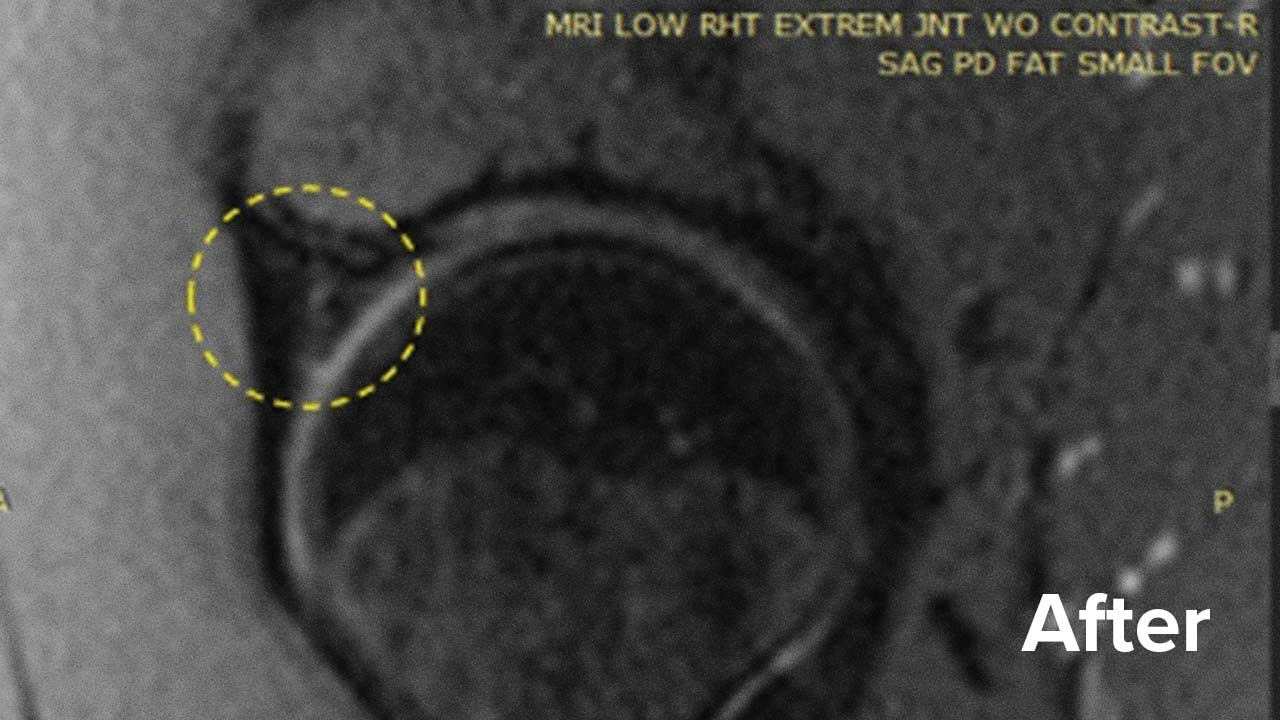
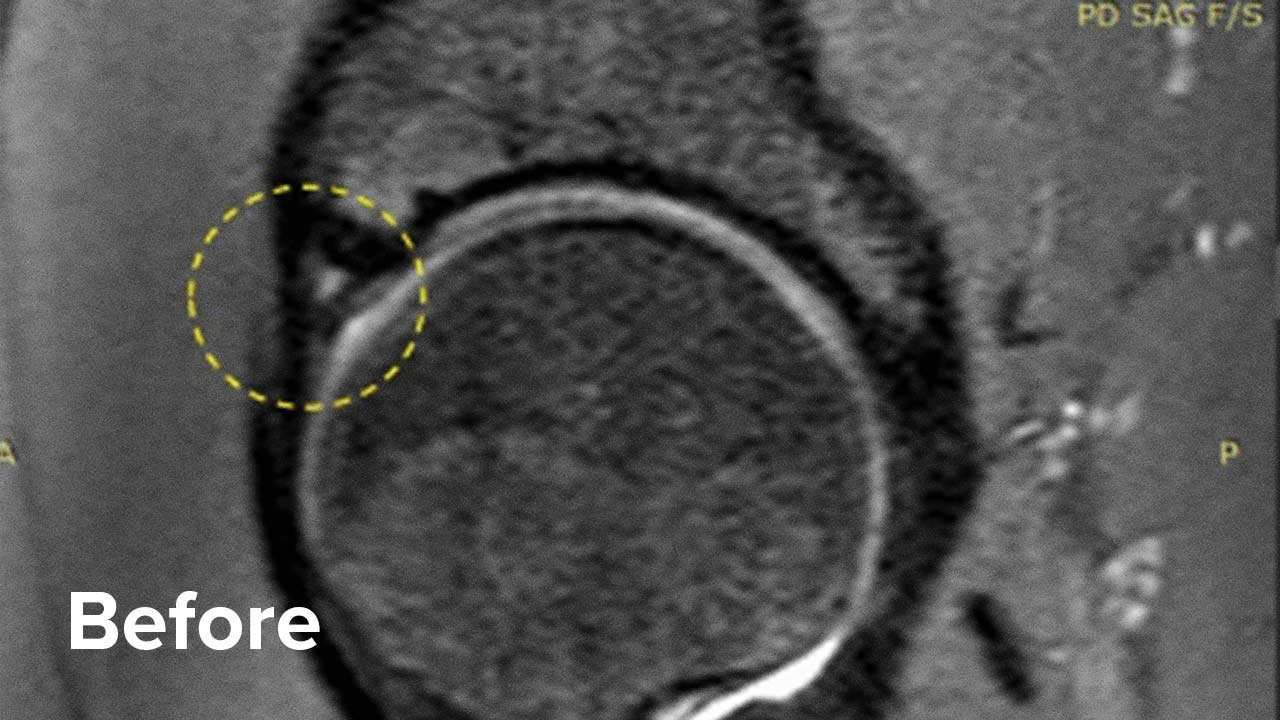
Patient 1 MRI
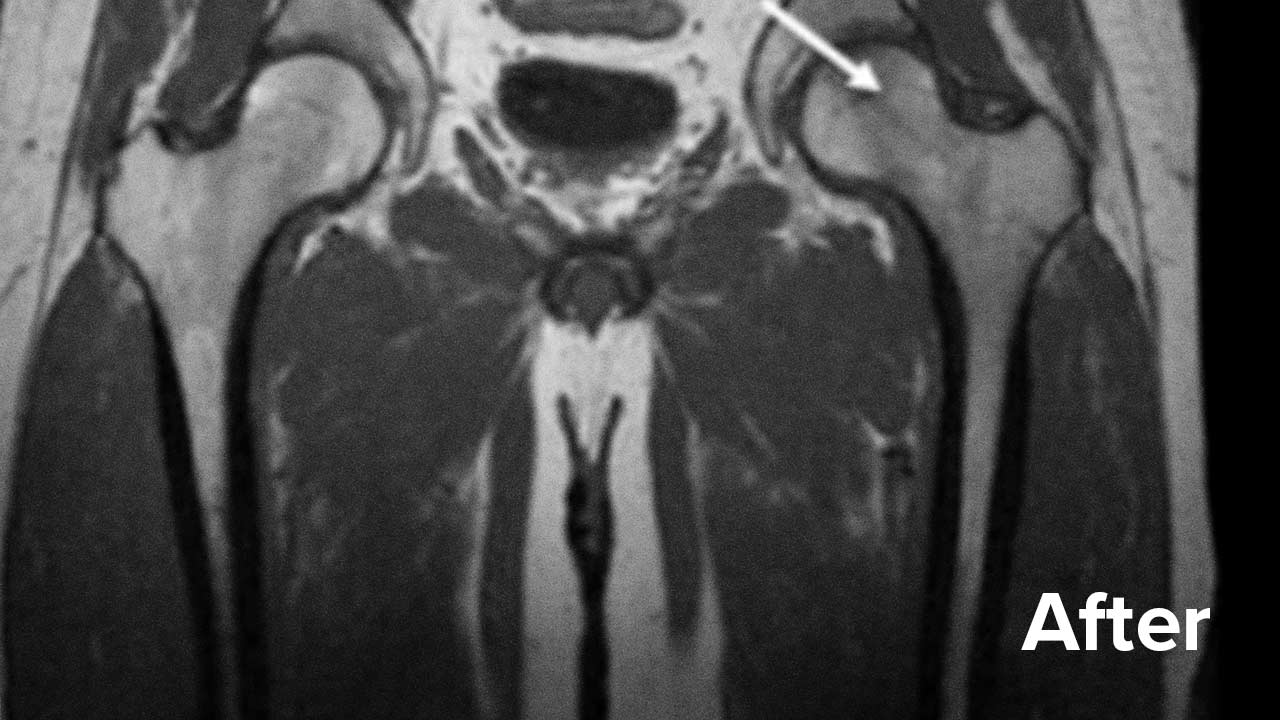

Patient 2 MRI
Webinar: Treating Hip Labrum Tears Without Surgery

Join Chris Centeno, M.D., founder of Regenexx, to learn how Regenexx procedures can help treat your hip pain without surgery and with a faster recovery.
During this free webinar you’ll learn:
- How procedures using bone marrow concentrate and platelet-rich plasma (PRP) compare to surgery and other hip pain treatment options
- Regenexx procedure expectations
- Answers to the most common questions about regenerative medicine treatments
FAQs
The hip labrum is a lip of cartilage that surrounds the socket (acetabulum) in the pelvis and helps secure and stabilize the head of the femur in the hip joint.
Hip labrum tears can be caused by:
- Structural issues: Conditions that cause abnormal hip movement can lead to hip labral tears. In femoroacetabular impingement (FAI), the head of the femur doesn’t fit into the socket properly and can cause long-lasting groin pain and movement limitations. FAI can affect people at any age and is the most common cause of hip labrum tears. Without treatment, it may result in osteoarthritis.
- Injury: Trauma to the hip can lead to a hip labrum tear and is particularly common in people who play certain sports with high-impact movements, such as ice hockey, football, soccer, and golf.
- Degenerative osteoarthritis: Osteoarthritis is a chronic degeneration of the cartilage between the joints. As cartilaginous structures like the labrum erode over time, they become more prone to tearing. Advanced age and excess body weight can increase a person’s risk for developing osteoarthritis.
No, labral tears can exist whether there’s hip pain or not. In fact, many hip labrum tears cause no signs or symptoms at all. If there is pain, it’s likely due to a separate issue like sacroiliac (SI) joint dysfunction, pinched nerves in the low back, or problems with hip girdle muscles, ligaments, or tendons.
Occasionally, you may experience one or more of the following with a hip labrum tear: a locking, clicking, or catching sensation in your hip joint; pain in your hip or groin; or stiffness or limited range of motion in your hip joint.
Yes, most hip labrum tears can be identified with an MRI. They provide good definition for large muscles, labrum and tendon tears, and areas of inflammation.
Request an Appointment
References
1. Krych AJ, Kuzma SA, Kovachevich R, Hudgens JL, Stuart MJ, Levy BA. Modest mid-term outcomes after isolated arthroscopic debridement of acetabular labral tears. Knee Surg Sports Traumatol Arthrosc. 2014;22(4):763-767. doi:10.1007/s00167-014-2872-1
2. Centeno CJ. Efficacy and Safety of Bone Marrow Concentrate for Osteoarthritis of the Hip; Treatment Registry Results for 196 Patients. J Stem Cell Res Ther 2014;04(10). doi:10.4172/2157-7633.1000242.
3. Friedlis MF, Centeno CJ. Performing a Better Bone Marrow Aspiration. Phys Med Rehabil Clin N Am. 2016 Nov;27(4):919-939. doi: 10.1016/j.pmr.2016.06.009. PMID: 27788908.
4. Centeno CJ, Kisiday J, Freeman M, Schultz JR. Partial regeneration of the human hip via autologous bone marrow nucleated cell transfer: A case study. Pain Physician. 2006 Jul;9(3):253-6.
- Torn Hip Labrum and Hip Osteoarthritis
- Hip Labrum Surgery Mania