

Non-Surgical Options for Managing Knee Osteoarthritis
Knee osteoarthritis (OA) is among the most commonly diagnosed orthopedic conditions. For individuals living with OA, the associated discomfort may interfere with daily activities and affect overall well-being.
Typically, individuals over 40 experiencing knee pain from osteoarthritis, commonly referred to as arthritis, may be advised to pursue conservative measures such as physical therapy, nonsteroidal anti-inflammatory medications (NSAIDs), or corticosteroid or hyaluronate injections to help manage inflammation and discomfort. If these approaches do not lead to meaningful improvement, arthroscopic surgery may be considered to address damaged cartilage or tissue. When symptoms persist following these interventions, total knee replacement is often presented as the next step.
Alternative to knee replacement surgery for osteoarthritis
Can Knee Surgery Help Reduce Pain?
Numerous studies[2] evaluating the outcomes of typical orthopedic knee surgeries suggest that these procedures may offer limited benefit, especially for individuals over the age of 40. Even in younger patients, success is not universal. Some patients are unaware that surgery may not always be the most appropriate solution.
Read on to learn more about the Regenexx approach, which offers an alternative to knee replacement surgery for osteoarthritis. These procedures utilize interventional orthobiologics to support the body’s natural healing response, and they may help reduce pain and improve function. Treatment is delivered by physicians in the licensed Regenexx network and is customized to individual needs.
2577 East 17th Street
Suite #18
Brooklyn, NY 11235
Request an Appointment
Call to Schedule Schedule OnlineClinic Hours
| Sunday | Closed |
| Monday | 9AM–5PM |
| Tuesday | 9AM–5PM |
| Wednesday | 9AM–5PM |
| Thursday | 9AM–5PM |
| Friday | 9AM–5PM |
| Saturday | Closed |
How Does the Regenexx Approach Work for Knee Osteoarthritis?
Physicians in the licensed Regenexx network at Pain Doctors Medical in Brooklyn, New York, utilize Regenexx procedures as part of an approach called interventional orthobiologics. This minimally invasive option compared to knee surgery uses image-guided injection of the individual’s own bone marrow concentrate directly into the joint.
The cellular elements in the concentrate may support the body’s natural healing response at the injury site and may help reduce the need for surgery.
The Regenexx Approach for Knee Arthritis
Physicians in the licensed Regenexx network at Pain Doctors Medical in Brooklyn, New York, conduct a thorough evaluation of movement patterns and may use ultrasound imaging to view the joint’s internal structures in real time. This approach provides a clearer understanding of what may be the cause of pain, how joint function is impacted, and what underlying issues are contributing to the condition.
Following this evaluation, the physician will develop a customized treatment plan. Recommended procedures may include:
Regenexx SD Injectate: A procedure using bone marrow concentrate, which contains stem cells, prepared according to Regenexx intellectual property.
Regenexx SCP Injectate: A proprietary formulation of platelet-rich plasma (PRP) that is more concentrated than PRP produced by typical bedside centrifuge devices.
Regenexx PL Injectate: Platelet lysate, a specialized derivative of platelet-rich plasma (PRP).
See how Regenexx helped Stephanie with her chronic pain from knee osteoarthritis.
Am I a candidate?Note: Like all medical procedures, Regenexx procedures have a success and failure rate. Not all patients will experience the same results.
BEFORE and AFTER MRI Images
Below are MRI images from two individuals who underwent procedures using Regenexx lab processes for knee osteoarthritis. Scroll the arrow to the right to view the MRI of the knee joint before treatment; the white/lighter area may indicate areas of joint degeneration. Scroll to the left to view the MRI of the knee joint following the procedure.
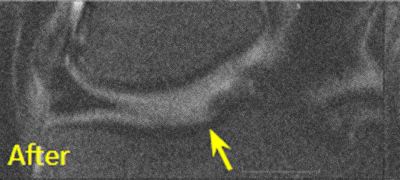
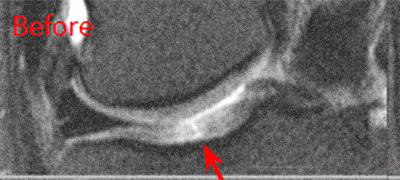
Patient 1 MRI: 51 years old
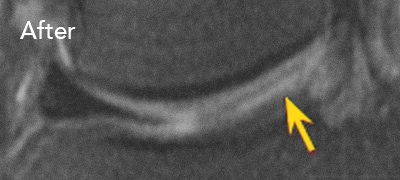
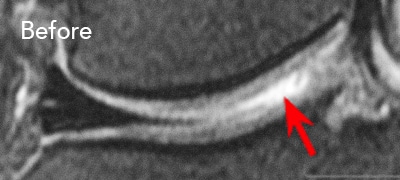
Patient 2 MRI: 46 years old
Patient 1:
This individual experienced limited improvement following a microfracture procedure and was unable to resume many daily activities. A procedure using a percutaneous injection of autologous cells processed using Regenexx lab methods was later performed. Following the procedure, the individual reported returning to routine functional activities.
Patient 2:
This individual underwent arthroscopic debridement, during which a 3 cm by 4 cm osteochondral defect on the medial femur was identified. Approximately 1.5 years after surgery, the individual received a percutaneous procedure involving autologous cells processed using Regenexx lab methods. Subsequent to the procedure, the individual reported resuming full functional activities.
Am I a candidate?Patient FAQs
The knee is a joint, and it is the largest one in the body. It is the point where the thigh bone (femur) connects with the shin bones (tibia and fibula). The ends of these bones are covered with a smooth, slippery tissue called cartilage, which may help reduce friction within the joint. This surface allows the bones to move against one another more easily and may help protect the joint from stress. The knee also contains two crescent-shaped pieces of fibrous cartilage called the meniscus. These structures contribute to joint stability and help distribute weight more evenly.
Over time, the knee joint is subjected to significant stress during weight-bearing activities. Like all joints, it goes through natural cycles of wear and repair, which can include cartilage thinning, the development of bone spurs, and other structural changes. In some cases, the body’s repair response can alter the joint’s shape or alignment. When this occurs, the bones may not remain properly aligned or adequately lubricated. Over time, this may lead to inflammation, pain, swelling, and stiffness, which are often associated with a condition called osteoarthritis. Contributing factors may include excess body weight, the natural aging process, or previous injury to the joint.
Arthritis is a general term used to describe inflammation of the joints. There are two primary types of arthritis:
- Osteoarthritis (OA) – also referred to as degenerative joint disease- is the most common form of arthritis. It occurs when the cartilage within a joint gradually wears away, commonly affecting the hips, knees, and spine.6
- Rheumatoid arthritis (RA) – is an autoimmune condition in which the immune system mistakenly targets the lining of the joints (synovium), resulting in inflammation and joint damage.7
Yes. An analysis of our data indicates that individuals with less advanced arthritis experienced similar outcomes to those with bone-on-bone arthritis. This observation is also supported by findings published by other researchers.8
Both X-rays and magnetic resonance imaging (MRI) can reveal changes in the joints associated with degenerative arthritis. However, symptoms of osteoarthritis may appear before visible damage is detectable on standard X-rays. For this reason, physicians often rely on MRI, which is more sensitive for identifying early signs of osteoarthritis. Additionally, MRI provides three-dimensional imaging, offering more detailed views compared to traditional X-rays.
Although cartilage plays a key role in joint function, its loss is not typically the direct source of pain. The MRI finding most consistently linked with pain is swelling within the bone, known as bone marrow edema (BME) or a bone marrow lesion (BML). Recent research on knee pain related to arthritis has shifted focus from cartilage deterioration to the presence of this bone marrow swelling.
No, they will not regenerate large areas of cartilage; however, they may help:
- Replenish diminished cellular reserves. The body’s natural supply of cells involved in repair and maintenance tends to decline with age and the progression of arthritis.
- Support cellular recovery. Research suggests that mesenchymal stem cells may transfer healthy mitochondria to neighboring cells with damaged mitochondria, potentially restoring function in those cells.
- Address bone lesions. Emerging evidence indicates that microfractures, rather than cartilage loss, are a primary contributor to pain.
- Modulate the joint environment. Arthritic joints often contain a mix of inflammatory and catabolic substances, and cellular therapies may help shift the environment toward one that is more supportive of tissue maintenance.
Request an Appointment
References
1, 4. Regenexx Patient Registry – Knee Outcomes. Lower Extremity Functional Scale (LEFS) questionnaire. Accessed on November 02, 2020.
2. Moseley JB, O’Malley K, Petersen NJ, Menke TJ, Brody BA, Kuykendall DH, Hollingsworth JC, Ashton CM, Wray NP. A controlled trial of arthroscopic surgery for osteoarthritis of the knee. N Engl J Med. 2002 Jul 11;347(2):81-8. doi: 10.1056/NEJMoa013259. PMID: 12110735. [Google Scholar]
Englund M, Guermazi A, Gale D, Hunter DJ, Aliabadi P, Clancy M, Felson DT. Incidental meniscal findings on knee MRI in middle-aged and elderly persons. N Engl J Med. 2008 Sep 11;359(11):1108-15. doi: 10.1056/NEJMoa0800777. PMID: 18784100. [Google Scholar]
Katz JN, Brophy RH, Chaisson CE, de Chaves L, Cole BJ, Dahm DL, Donnell-Fink LA, Guermazi A, Haas AK, Jones MH, Levy BA, Mandl LA, Martin SD, Marx RG, Miniaci A, Matava MJ, Palmisano J, Reinke EK, Richardson BE, Rome BN, Safran-Norton CE, Skoniecki DJ, Solomon DH, Smith MV, Spindler KP, Stuart MJ, Wright J, Wright RW, Losina E. Surgery versus physical therapy for a meniscal tear and osteoarthritis. N Engl J Med. 2013 May 2;368(18):1675-84. doi: 10.1056/NEJMoa1301408. Epub 2013 Mar 18. Erratum in: N Engl J Med. 2013 Aug 15;369(7):683. PMID: 23506518 [Google Scholar]
Sihvonen R, Englund M, Turkiewicz A, Järvinen TL; Finnish Degenerative Meniscal Lesion Study Group. Mechanical Symptoms and Arthroscopic Partial Meniscectomy in Patients With Degenerative Meniscus Tear: A Secondary Analysis of a Randomized Trial. Ann Intern Med. 2016 Apr 5;164(7):449-55. doi: 10.7326/M15-0899. Epub 2016 Feb 9.PMID: 26856620. [Google Scholar]
van de Graaf VA, Noorduyn JCA, Willigenburg NW, Butter IK, de Gast A, Mol BW, Saris DBF, Twisk JWR, Poolman RW; ESCAPE Research Group. Effect of Early Surgery vs Physical Therapy on Knee Function Among Patients With Nonobstructive Meniscal Tears: The ESCAPE Randomized Clinical Trial. JAMA. 2018 Oct 2;320(13):1328-1337. doi: 10.1001/jama.2018.13308. Erratum in: JAMA. 2018 Dec 4;320(21):2272-2273. Erratum in: JAMA. 2020 Mar 10;323(10):1001. PMID: 30285177. [Google Scholar]
3. Regenexx Patient Registry – Knee Outcomes. Numeric Pain Scale (NPS) questionnaire. Accessed on November 02, 2020.
5. Regenexx Patient Registry – Knee Outcomes. Single Assessment Numeric Evaluation (SANE) questionnaire. Accessed on November 02, 2020.
6. NIH: National Institute of Arthritis and Musculoskeletal and Skin Diseases. Accessed October 5, 2020.
7. Arthritis Foundation. Accessed November 02, 2020.
8. Xia Z, Ma P, Wu N, Su X, Chen J, Jiang C, Liu S, Chen W, Ma B, Yang X, Ma Y, Weng X, Qiu G, Huang S, Wu Z. Altered function in cartilage derived mesenchymal stem cell leads to OA-related cartilage erosion. Am J Transl Res. 2016 Feb 15;8(2):433-46. PMID: 27158337. [Google Scholar]