

ACL Tear Repair Without Surgery At Pain Doctors Medical
Are You a Regenexx Candidate?This location is for evaluation appointments only.
Anterior Cruciate Ligament (ACL) injuries are prevalent knee conditions frequently managed by physicians in the licensed Regenexx network. While typical surgical intervention has served as a primary treatment for complete ACL tears, newer, minimally invasive options utilizing interventional orthobiologics are now accessible.
Procedures using Regenexx lab processes, such as Perc-ACLR (percutaneous ACL repair), may present an alternative strategy for managing specific ACL injuries. This methodology leverages the body’s own healing agents to support the natural repair process, potentially helping individuals avoid the necessity of typical surgery. In suitable cases—particularly those involving non-retracted partial or full tears—these procedures may help reduce discomfort and may improve stability in the joint.
Repair of ACL tear without surgery
ACL Tear Recovery Time Without Surgery
When thoroughly assessing options following an Anterior Cruciate Ligament (ACL) injury, it is important to weigh all treatment approaches. Considerations should include the anticipated recovery timeline, the potential for returning to activity, and the possible long-term effects on joint health.
Procedures using Regenexx injectates are developed with the aim of preserving the existing ACL structure whenever possible, rather than requiring surgical removal or replacement.
The Perc-ACLR procedure, which uses Regenexx lab processes, utilizes image-guided delivery of the individual’s own bone marrow concentrate. This minimally invasive technique is typically completed in a single day. In appropriate clinical cases, this option may support the body’s natural healing response and may provide a shorter recovery period compared to typical surgical intervention.
| Perc-ACLR | Surgery | |
|---|---|---|
| Procedure Invasiveness | Much less | Much more |
| Return to Sports | 3 to 6 months | 1 year |
| Keep your ACL | Yes | NO |
| Recovery | Brace, much less extensive PT | Crutches, brace, extensive PT |
495 North 13th Street
Newark, NJ 07107
Request an Appointment
Call to Schedule Schedule OnlineClinic Hours
| Sunday | Closed |
| Monday | 9AM–5PM |
| Tuesday | 9AM–5PM |
| Wednesday | 9AM–5PM |
| Thursday | 9AM–5PM |
| Friday | 9AM–5PM |
| Saturday | Closed |
How Does the Regenexx Approach Work?
The Regenexx approach uses interventional orthobiologics, which is a specialized form of orthopedic care. This methodology was developed as a minimally invasive alternative to typical ACL surgery.
These procedures utilize advanced image-guidance, such as ultrasound or fluoroscopy, to ensure the precise delivery of the individual’s own bone marrow concentrate directly to the injury site within the knee joint. The healing agents present in the bone marrow concentrate may help support the body’s natural healing response. This method may assist patients with certain ACL tears, potentially avoiding the need for surgical intervention.
Regenexx for ACL Tears: Perc-ACLR
Available at Pain Doctors Medical – 495 North 13th Street Newark, New Jersey
The Perc-ACLR procedure, which uses Regenexx injectates and proprietary methods, may provide a minimally invasive option instead of typical ACL surgery. This treatment is frequently completed within the span of a single day.
The procedure involves several steps performed by a physician in the licensed Regenexx network:
- Extraction: The physician begins by extracting a small quantity of the individual’s bone marrow. This is accomplished using precise imaging guidance and specialized techniques licensed by Regenexx.
- Processing: The collected bone marrow is then processed by a trained lab technician according to proprietary Regenexx protocols.
- Reinjection: The physician utilizes advanced imaging, such as fluoroscopy (real-time X-ray guidance) and MRI imaging with contrast, to develop a thorough map of the ACL tear. This roadmap assists the physician in precisely depositing the processed bone marrow concentrate into the targeted areas of the ligament. Local anesthesia is applied to enhance patient comfort during the reinjection.
Following the procedure, patients may experience mild joint soreness, which can last for one to three days. Many individuals report functional improvement within a month, often beginning physical therapy and light activity during early recovery.
Available for consultation at Pain Doctors Medical, 495 North 13th Street, Newark, New Jersey.
Note: Individual outcomes may vary. For more information about patient outcomes, please visit our Patients’ Results page: https://regenexx.com/results/.
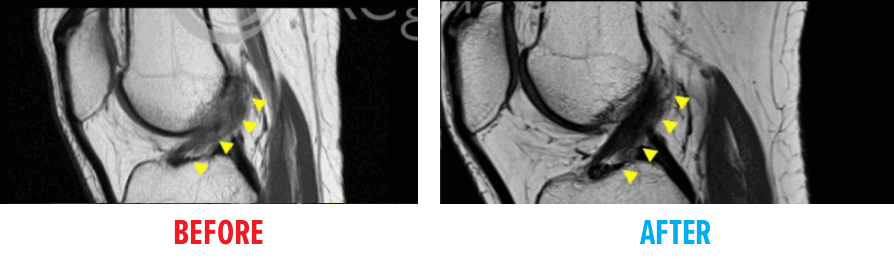
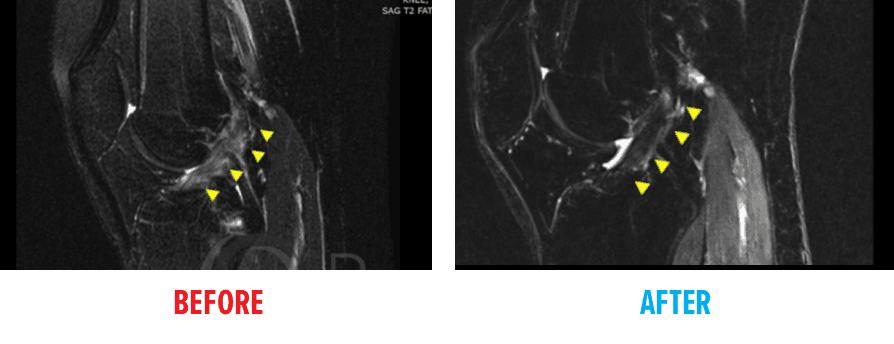
Before and After MRI Images
These MRI images visually demonstrate the structural changes noted in individuals who had procedures using Regenexx lab processes as a potential alternative to typical ACL surgery.
In the “before” image, the Anterior Cruciate Ligament (ACL) structure appears disrupted. Following the procedure, the “after” image shows a more continuous dark band running diagonally across the joint, which is an appearance often associated with a more intact ligament structure.
FAQs
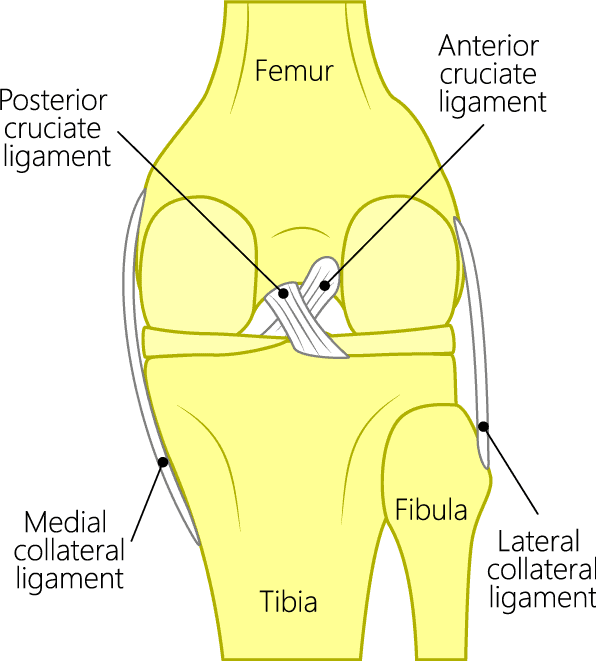
Knee joint anatomy showing ACL
The knee joint contains two cruciate ligaments—named for their cross-like arrangement—that help stabilize the joint. These ligaments intersect to form an X: the anterior cruciate ligament (ACL) is positioned at the front, while the posterior cruciate ligament (PCL) lies at the back. The ACL prevents the shinbone from sliding too far forward, and the PCL stops it from sliding backward.
ACL surgery is typically not considered an emergency unless there is severe damage to surrounding structures, pronounced joint instability, or unmanageable pain. In many cases, adults with some degree of knee stability can postpone surgery for one to two months. For young athletes, the recommended waiting period may be shorter, often influenced by the goal of a quicker return to sports. Some patients may benefit from starting with physical therapy to support recovery. If symptoms persist, nonsurgical alternatives like Perc-ACLR may be explored before proceeding with surgery.
Studies have shown that ACL sprains, and in some cases, even complete tears, may have the potential to heal without surgical intervention, particularly when interventional orthopedic treatments like the Perc-ACLR procedure are used. These non-surgical approaches harness the body’s natural healing mechanisms to support ligament repair. Given this potential for natural healing, surgical reconstruction may not be the only option for addressing ACL injuries.
ACL sprains, tears, and ruptures are often used interchangeably, as they all refer to varying degrees of injury to the anterior cruciate ligament. Clinically, these injuries are categorized as sprains and graded based on severity:
- Grade 1 Sprain: The ligament is slightly overstretched but remains intact and capable of maintaining knee joint stability.
- Grade 2 Sprain: The ligament is partially torn or more significantly stretched, resulting in some looseness within the joint. This is commonly referred to as a partial tear.
- Grade 3 Sprain: This represents a complete tear of the ligament, in which the ACL is fully disrupted, often split into two parts, leading to marked joint instability.
The term ACL rupture typically refers to a complete, full-thickness tear, equivalent to a Grade 3 sprain, and may involve visible ligament deformity or retraction.
Statistically, only about half of athletes who undergo ACL reconstruction regain full function after rehabilitation and are able to return to their previous level of sport. The remaining half may recover knee stability but often do not regain normal biomechanics or proprioception equal to the uninjured knee. Some may also experience functional limitations in daily life. It is advisable to seek a second opinion before proceeding with surgery, as conventional ACL reconstruction carries several documented risks and the initial injury may have been misdiagnosed. While surgery can be appropriate for certain cases, the majority of individuals may be able to avoid it.
Approximately 17 percent of adults report anterior knee pain or pain while kneeling after surgery, and between 5 percent and 29 percent experience graft failure and loss of knee stability, with higher failure rates seen in younger patients. Other potential complications include knee stiffness or loss of range of motion (approximately 5 percent), painful hardware (approximately 6 percent), infection (approximately 1 percent to 2 percent), and patellar tendon rupture or patellar fracture in cases involving bone-to-bone grafts.³⁻⁶
Rising participation in high-intensity elite sports among youth has led to increased ACL reconstruction surgeries in young teens. However, emerging research suggests that postsurgical complications may be more pronounced in children than in adults. If the goal is to preserve one’s natural physical structure and “keep original parts and structures intact,” a nonsurgical option like Perc-ACLR may be worth considering.
A large review of 160 clinical trials found higher complication rates among young adolescents undergoing ACL repair, including increased risk of growth disturbances, skeletal deformities, and ligament rerupture that may require revision surgery. The study focused on a skeletally immature population with an average age of 13.⁷
Additionally, a 2010 Swedish study challenged the belief that surgery is the only path to healing. Among athletes with an average age of 26 who followed a strict physical therapy regimen instead of surgery, 60 percent never required ligament reconstruction and were still able to return to sports.⁸
ACL tears can be classified in many ways, but within regenerative medicine, they are typically grouped into three primary types: partial-thickness, full-thickness non-retracted, and full-thickness retracted tears. Both partial-thickness and full-thickness non-retracted tears may be suitable for treatment using regenerative approaches such as the Regenexx knee Perc-ACL procedure, which promotes healing without the need for surgery. In contrast, full-thickness retracted tears usually require surgical repair to restore proper function.
- Partial-Thickness ACL Tear
A partial-thickness tear does not extend through the entire ligament. Imaging typically reveals that a portion of the ACL remains intact, indicating that the tear is incomplete. - Full-Thickness Non-Retracted ACL Tear
This type of tear involves a complete disruption of the ligament fibers; however, the torn ends have not separated significantly. The ligament is fully torn, but the pieces remain aligned and have not recoiled or retracted, making it potentially responsive to regenerative treatment. - Full-Thickness Retracted ACL Tear
In this case, the ligament has torn completely, and the ends have pulled apart—often recoiling like a stretched rubber band that snaps. This displacement generally limits the success of nonsurgical options and typically necessitates surgical reconstruction.
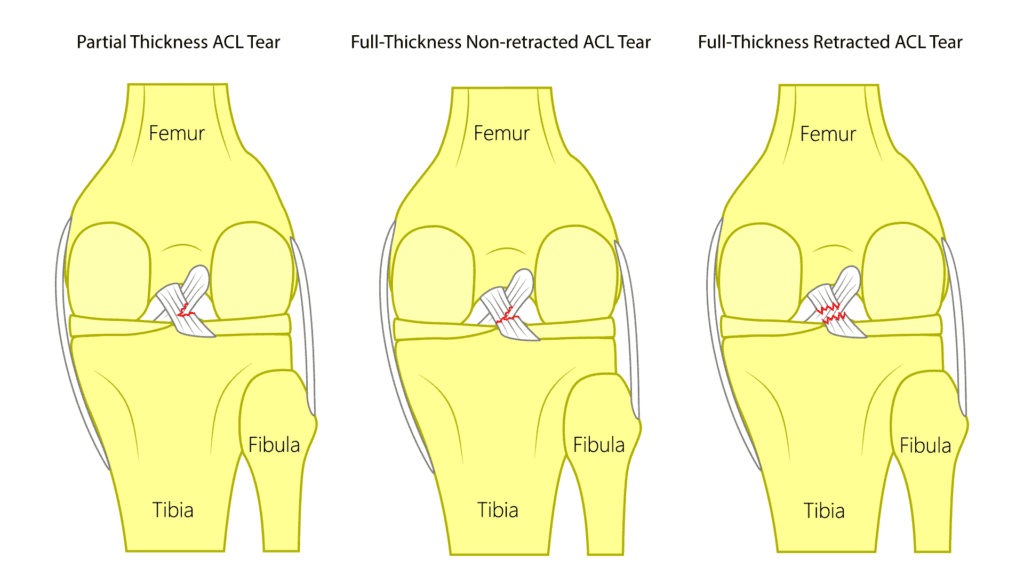
ACL tears
Get started to see if you are a Regenexx candidate
To talk one-on-one with one of our team members about how the Regenexx approach may be able to help your orthopedic pain or injury, please complete the form below and we will be in touch with you within the next business day.
References
1. Centeno C, Markle J, Dodson E, Stemper I, Williams C, Hyzy M, Ichim T, Freeman M. Symptomatic anterior cruciate ligament tears treated with percutaneous injection of autologous bone marrow concentrate and platelet products: a non-controlled registry study. J Transl Med. 2018 Sep 3;16(1):246. doi: 10.1186/s12967-018-1623-3. PMID: 30176875. PMID: 30176875. [Google Scholar]
2. Costa-Paz M, Ayerza MA, Tanoira I, Astoul J, Muscolo DL. Spontaneous healing in complete ACL ruptures: a clinical and MRI study. Clin Orthop Relat Res. 2012 Apr;470(4):979-85. doi: 10.1007/s11999-011-1933-8. PMID: 21643922. [Google Scholar]
3. Freedman KB, D’Amato MJ, Nedeff DD, Kaz A, Bach BR Jr. Arthroscopic anterior cruciate ligament reconstruction: a metaanalysis comparing patellar tendon and hamstring tendon autografts. Am J Sports Med. 2003 Jan-Feb;31(1):2-11. doi: 10.1177/03635465030310011501. PMID: 12531750. [Google Scholar]
4. Webster KE, Feller JA, Leigh WB, Richmond AK. Younger patients are at increased risk for graft rupture and contralateral injury after anterior cruciate ligament reconstruction. Am J Sports Med. 2014 Mar;42(3):641-7. doi: 10.1177/0363546513517540. Epub 2014 Jan 22. PMID: 24451111. [Google Scholar]
5. Burks RT, Friederichs MG, Fink B, Luker MG, West HS, Greis PE. Treatment of postoperative anterior cruciate ligament infections with graft removal and early reimplantation. Am J Sports Med. 2003 May-Jun;31(3):414-8. doi: 10.1177/03635465030310031501. PMID: 12750136. [Google Scholar]
6. Kovacic JJ in Complications of Anterior Cruciate Ligament Surgery, AAOS Monograph Series 2005. Accessed August 25, 2020.
7. Wong SE, Feeley BT, Pandya NK. Complications After Pediatric ACL Reconstruction: A Meta-analysis. J Pediatr Orthop. 2019 Sep;39(8):e566-e571. doi: 10.1097/BPO.0000000000001075. PMID: 31393290. [Google Scholar]
8. Frobell RB, Roos EM, Roos HP, Ranstam J, Lohmander LS. A randomized trial of treatment for acute anterior cruciate ligament tears. N Engl J Med. 2010 Jul 22;363(4):331-42. doi: 10.1056/NEJMoa0907797. Erratum in: N Engl J Med. 2010 Aug 26;363(9):893. PMID: 20660401. [Google Scholar]